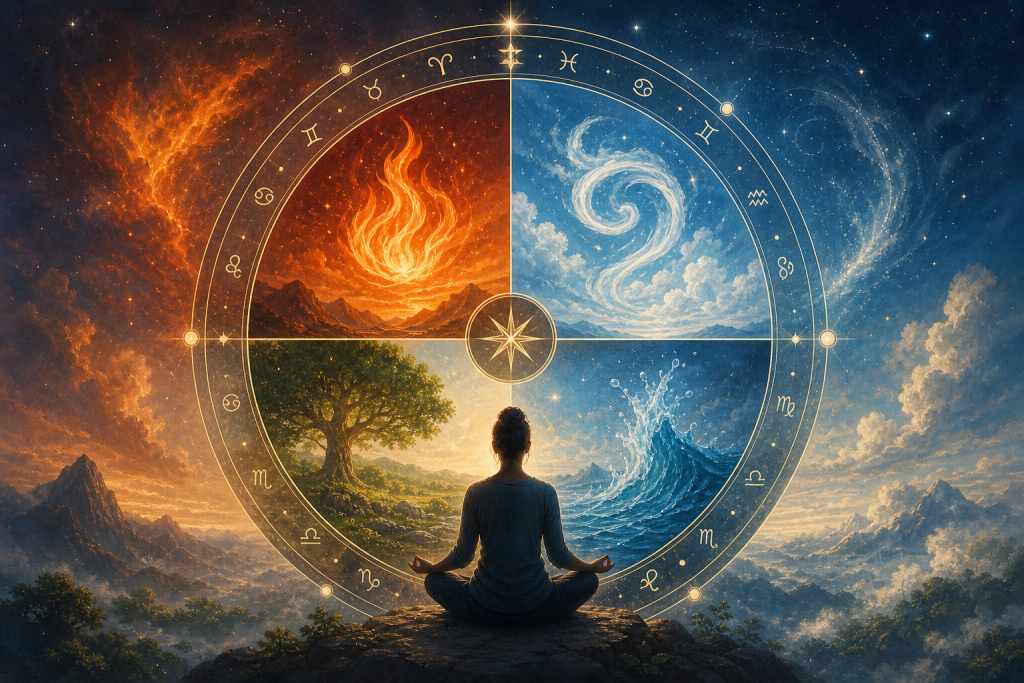
Astrology often starts with the big three: Sun, Moon, and Rising signs. But if you want a more practical way to understand your chart, the four elements offer a clear starting point. Fire, Earth, Air, and Water describe the basic style of energy in astrology, and looking at their balance can show where your chart feels natural, where it may feel stretched, and where you may need more conscious development.
This approach is not about labeling a chart as “good” or “bad.” Instead, it helps you notice patterns. A chart heavy in one element may express itself with strong consistency, while a chart with less of that element may need different tools to access the same kind of energy. Used thoughtfully, the elements can turn a birth chart from a list of placements into a practical self-awareness tool.
What the Four Elements Mean in Astrology
Each element represents a different mode of expression. When you look at your chart, you are not just counting signs; you are noticing how energy tends to move through your personality and choices.
Fire: action, confidence, inspiration
Fire signs are Aries, Leo, and Sagittarius. Fire tends to be direct, expressive, and future-oriented. In a chart, strong Fire often points to enthusiasm, initiative, and a need for movement or meaning. Too much Fire can sometimes show up as impatience or a tendency to act before pausing to reflect.
Earth: structure, practicality, reliability
Earth signs are Taurus, Virgo, and Capricorn. Earth energy is grounded, tangible, and results-focused. A chart with strong Earth often values stability, routine, and useful outcomes. When Earth is emphasized, there may be a strong instinct to build, organize, and make things last. When Earth is low, practical follow-through may require more intention.
Air: ideas, communication, perspective
Air signs are Gemini, Libra, and Aquarius. Air is associated with thought, language, social exchange, and analysis. A chart with strong Air often seeks understanding through conversation, patterns, and objectivity. If Air is underrepresented, it may be harder to step back and name what is being felt or observed.
Water: emotion, intuition, connection
Water signs are Cancer, Scorpio, and Pisces. Water is sensitive, responsive, and deeply receptive. Strong Water in a chart often points to emotional depth, intuition, and strong relational awareness. If Water is limited, emotional processing may happen more through reasoning or action than through feeling directly.
How to Find Your Element Balance
To assess your element balance, start with the main placements in your chart: Sun, Moon, Rising, Mercury, Venus, Mars, and the outer planets. Then note the sign of each placement and group them by element. You can also consider the houses, but signs are the easiest place to begin.
For example, if your Sun is in Leo, Moon in Scorpio, Rising in Virgo, Mercury in Gemini, Venus in Cancer, and Mars in Aries, you would have Fire, Water, Earth, Air, Water, and Fire represented. That does not mean your chart is “two Fire, two Water, one Earth, one Air” in a strict scientific sense. It means those elements are likely to color your experiences in noticeable ways.
Helpful questions to ask:
- Which element appears most often in my personal planets?
- Which element is least represented in my chart?
- Does the chart feel different when I include the Ascendant and chart ruler?
- Do I express certain elements more easily than others?
What Element Imbalance Can Look Like
Element balance is not a diagnosis. It is simply a way to observe tendencies. A chart with many placements in one element may naturally lean toward that style, while a missing element may describe an area that requires more conscious practice.
Too much Fire
A strong Fire emphasis may bring enthusiasm and courage, but it can also create restlessness or a tendency to move too fast. Balance may come from Earth-like habits such as planning, pacing, and following through.
Too much Earth
Heavy Earth can create steadiness and discipline, but it may also make change feel difficult. Air-like practices such as conversation, curiosity, and mental flexibility can help bring movement to a very fixed routine.
Too much Air
Strong Air may support wit, objectivity, and social ease, yet it can also lead to overthinking or detachment. Water-like habits such as reflection, emotional check-ins, and quiet time may help deepen the connection to feeling.
Too much Water
Emphasized Water can bring empathy and intuition, though it may also create emotional flooding or difficulty separating personal feelings from outside influences. Fire-like action and Earth-like structure can help translate sensitivity into grounded choices.
How to Work With a Missing Element
When an element is less visible in a chart, the goal is not to “fix” it. The goal is to build skills that support it. A chart low in one element may still function well, but that energy may not come as naturally.
Practical ways to work with each missing element:
- Missing Fire: Try activities that encourage initiative, movement, and self-expression.
- Missing Earth: Build routines, use lists, and focus on concrete next steps.
- Missing Air: Journal, talk things through, and practice naming ideas clearly.
- Missing Water: Make space for solitude, emotional reflection, and intuitive listening.
The point is not to become someone else. It is to give your chart more range. Many people find that the missing element is less about personality flaws and more about an area that needs practice, attention, or support.
Why Element Balance Matters in Chart Interpretation
Element balance can add nuance to almost any astrology reading. A person with a bold Sun sign may still be emotionally reserved if their chart is Air- and Earth-heavy. Someone with a calm-looking chart may be more intense than expected if Water or Fire is strongly emphasized. This is why element analysis is so useful: it helps explain why two people with the same Sun sign can feel completely different.
Element balance does not replace the rest of chart interpretation. It gives you a clearer sense of the style behind the symbolism.
It can also help you understand why certain environments, relationships, or habits feel energizing or draining. A chart that is low in Earth may feel better with structure, while a chart low in Water may need more emotional spaciousness. These observations are not fixed rules, but they can be valuable clues.
Conclusion
Using the elements to balance your birth chart is one of the simplest ways to make astrology more practical. Fire shows how you act, Earth shows how you stabilize, Air shows how you think, and Water shows how you feel. When you notice which elements are strong or quiet in your chart, you gain a more complete picture of your natural style and your growth edges. That makes the chart not just descriptive, but useful.