Chinese astrology is often introduced through animals, elements, and compatibility charts, but one of its most practical concepts is the idea of clash signs. A clash happens when two earthly branches sit directly opposite each other in the Chinese zodiac cycle. Instead of suggesting a simple “good” or “bad” match, clash signs point to tension, movement, and the need for awareness. In other words, they describe where life may feel less settled and where extra care can make a difference.
If you have ever wondered why certain years, relationships, or decisions seem more disruptive than expected, the clash system offers a useful lens. It is a core part of Chinese astrology, and it shows up in birth charts, yearly forecasts, and relationship analysis. Understanding it can help you read Chinese astrology with more nuance and less superstition.
What a Chinese zodiac clash is
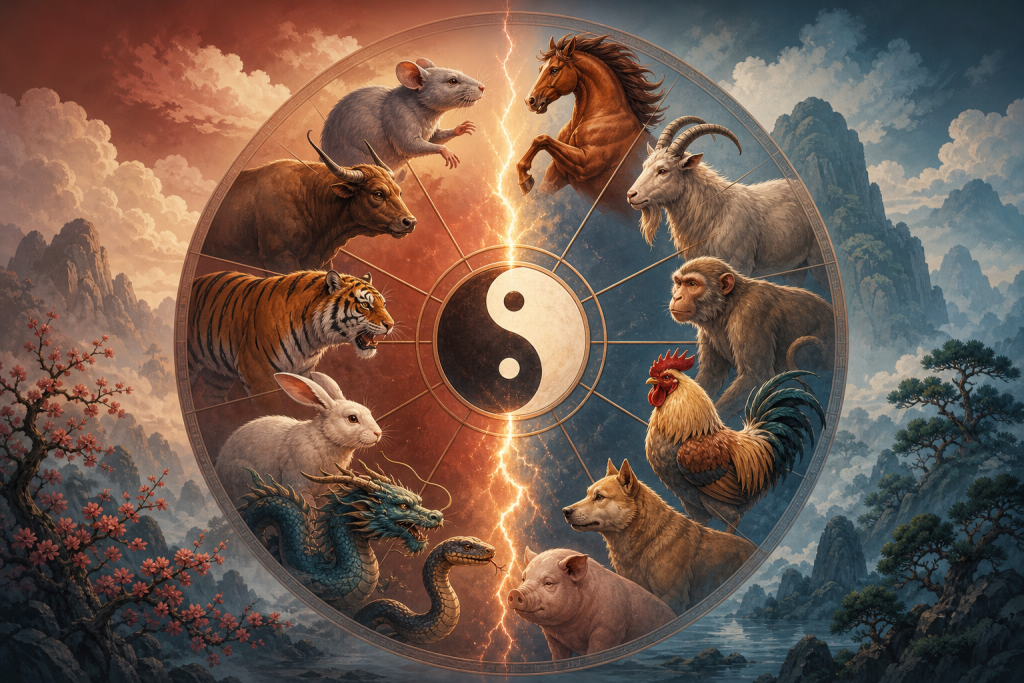
In Chinese astrology, each zodiac animal is connected to an earthly branch. The 12 branches form a circular system, and some pairs sit six steps apart. These opposite pairs are called clash signs. The idea is not that one sign defeats the other. Rather, their energies move in different directions, creating friction, change, or instability when they interact closely.
Clashes are often described as a push-pull dynamic. One sign may prefer speed while the other values caution. One may be direct while the other is more indirect. Because of this, clash relationships can feel exciting, stressful, or both at once.
The six zodiac clash pairs
- Rat clashes with Horse
- Ox clashes with Goat
- Tiger clashes with Monkey
- Rabbit clashes with Rooster
- Dragon clashes with Dog
- Snake clashes with Pig
These pairs are the foundation of the clash system. If your zodiac sign is one of them, the opposite sign may feel especially challenging in some contexts. That does not mean the pairing is impossible. It simply means the relationship may require more effort, patience, and flexibility.
Why clashes matter in Chinese astrology
Clashes are important because they show where energy is likely to move quickly or unevenly. In traditional Chinese metaphysics, this can matter for relationships, timing, and personal planning. A clash does not automatically produce a negative result, but it may highlight an area where life feels less predictable.
For example, a clash can point to:
- Frequent misunderstandings in communication
- Different priorities or habits
- Sudden changes in plans
- Restlessness or impatience
- The need to adapt rather than force an outcome
Seen this way, a clash is less about conflict for its own sake and more about energetic contrast. It is a signal to pay attention.
How clash signs are used in real readings
Chinese astrology does not usually rely on the zodiac animal alone. A full reading considers the year, month, day, and hour branches, along with elements and other relationships. Even so, clash signs are often one of the first things people notice because they are easy to identify and easy to apply.
In relationships
In compatibility readings, a clash can suggest that two people may approach life differently. That can show up in communication style, pace, emotional expression, or decision-making. A clash does not mean there is no connection. It means the connection may need more awareness and compromise.
For example, one person may want quick action while the other wants to study every detail. One may value structure while the other prefers spontaneity. When a clash is present, the relationship may work best when both people recognize the difference instead of trying to erase it.
In yearly astrology
Many people notice their zodiac sign when a year directly clashes with it. In Chinese astrology, that can be a year of movement, adjustment, or change. The emphasis is often on being more careful with commitments, routines, and expectations. Again, this is not a prediction of disaster. It is a reminder that the year may feel less stable than usual.
Some readers use this information to stay more organized, avoid impulsive choices, and leave room for flexibility. The value of the clash system is that it encourages awareness before tension becomes a problem.
In personal decision-making
People also use clash signs when choosing dates for important events, selecting partners for projects, or understanding why a certain interaction feels difficult. In this context, the clash system acts like a timing and relationship map. It does not make decisions for you, but it can highlight where extra caution may be useful.
Clash does not always mean “bad”
One of the most common mistakes is treating clash signs as if they are purely negative. In practice, clashes can be productive. They can create momentum, force honest conversations, and expose weak spots that need attention. Sometimes progress requires disruption.
Think of a clash as tension with a purpose. It may show where habits are outdated, where communication is unclear, or where circumstances are ready to change. If handled well, the energy of a clash can lead to growth rather than conflict.
In Chinese astrology, a clash is less a warning sign than a spotlight: it reveals where life may need more balance, patience, and awareness.
How to work with clash energy
You do not need to fear clash signs. A more practical approach is to respond thoughtfully when they appear in your chart or in a relationship. That often means slowing down, clarifying expectations, and avoiding assumptions.
- Pause before reacting. Clash energy can feel fast, so deliberate responses help.
- Check assumptions. Differences are not always personal.
- Build flexibility. Leave room for changes in plans or timing.
- Focus on communication. Clear language reduces avoidable friction.
- Look at the full chart. One clash does not define the entire reading.
These habits are useful whether you are studying your own chart or learning how another person fits into it. The goal is not to eliminate tension completely, but to understand it.
A balanced way to read clash signs
Chinese zodiac clash signs are a reminder that astrology is not only about harmony. It also describes contrast, movement, and the places where life asks for adjustment. When you understand the six clash pairs, you gain a clearer view of how Chinese astrology interprets relationships and timing.
Used well, this concept can make a reading more practical and grounded. It helps explain why some situations feel naturally smooth while others require more effort. Most of all, it encourages a balanced approach: notice the tension, but do not overstate it. In Chinese astrology, awareness is often more useful than fear.