Astrology gets much more useful when you understand planetary rulerships. Rulerships show which planets “govern” which zodiac signs, and that connection helps explain why certain signs express themselves the way they do. Instead of treating a sign as a random bundle of traits, rulerships reveal an underlying logic: each sign is linked to a planet that colors its style, motivation, and priorities.
This topic is especially helpful if you want to read charts more accurately. Planetary rulerships can clarify why some placements feel natural, why others feel challenged, and why a chart often has a few planets that carry extra influence. Learning this layer of astrology gives you a more structured way to interpret signs, houses, and chart patterns.
What Planetary Rulership Means
In astrology, a planet is said to rule a zodiac sign when its symbolism matches the sign’s core expression. The ruling planet acts like a manager or guide for that sign. For example, Mars rules Aries, so Aries traits often reflect Mars themes such as action, drive, initiative, and directness.
Rulership does not mean a sign is controlled in a rigid way. Rather, it means the sign and planet share a symbolic language. When a planet rules a sign, it helps explain how that sign tends to operate in everyday life and in the birth chart.
The Traditional Rulers of the Zodiac
Most astrology readers begin with the traditional rulership system. This system assigns one or two signs to each planet, based on longstanding astrological practice.
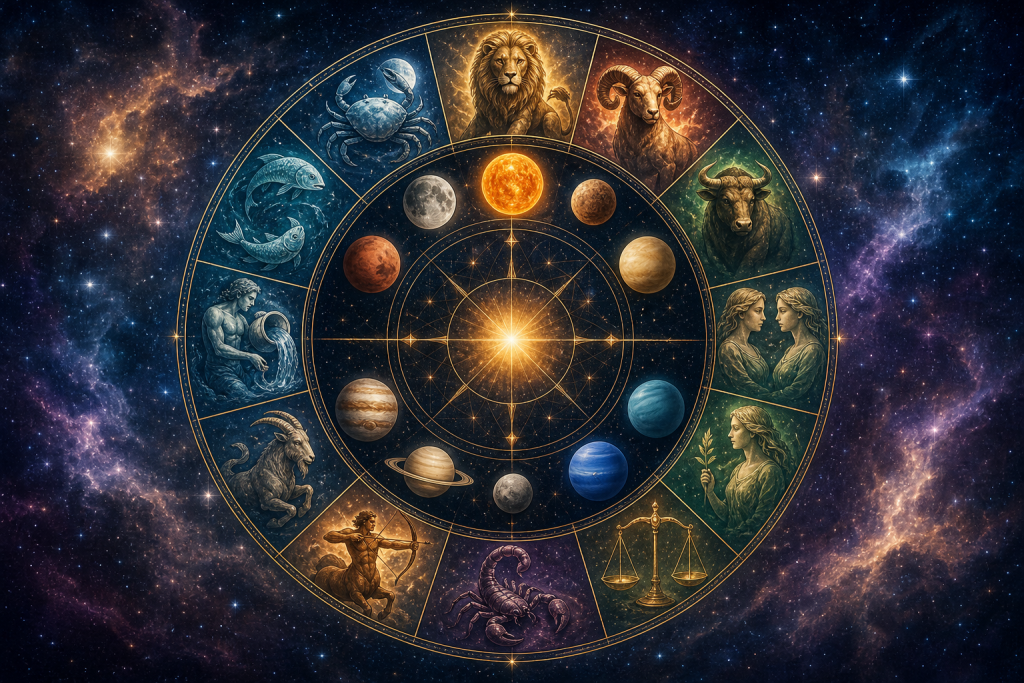
- Sun rules Leo
- Moon rules Cancer
- Mercury rules Gemini and Virgo
- Venus rules Taurus and Libra
- Mars rules Aries
- Jupiter rules Sagittarius
- Saturn rules Capricorn
- Uranus rules Aquarius in modern astrology
- Neptune rules Pisces in modern astrology
- Pluto rules Scorpio in modern astrology
Traditional astrology uses Saturn as the ruler of Aquarius and Mars as the ruler of Scorpio. Modern astrology often assigns Aquarius to Uranus and Scorpio to Pluto. Both systems are used, so it helps to know which approach your source is following.
Why Rulerships Matter in a Birth Chart
Rulerships matter because they create connections between signs, planets, and houses. If a planet is in the sign it rules, it tends to express itself with more ease and confidence. This is often described as being in its domicile.
For example, Mercury in Gemini may feel especially at home in communication, learning, and quick thinking. Venus in Taurus may emphasize steadiness, pleasure, and practical values. In these cases, the planet’s symbolism and the sign’s symbolism reinforce each other.
Rulerships also help you trace chart emphasis. If a planet rules multiple signs, or if several placements point back to the same planet, that planet may become especially important in interpretation.
How to Use Rulerships When Reading a Chart
1. Identify the sign of a planet
Start by noting which sign a planet is in. Then ask whether that sign is ruled by the planet itself or by another planet. This tells you whether the planet is operating from a place of strength, support, or dependence.
2. Find the ruler of the house
Each house begins in a sign, and that sign’s ruler becomes the house ruler. This is one of the most practical uses of rulerships. If the 7th house begins in Libra, Venus becomes the ruler of partnership themes in that chart. The condition and placement of Venus can offer clues about how relationships are approached.
3. Follow the chain of rulership
If a house ruler is located in another house, that creates a symbolic link between life areas. For instance, if the ruler of the 10th house is in the 4th house, career matters may be tied to home, family, or private life. This technique is often called chart rulership tracing.
4. Notice repeated rulers
When one planet rules several important placements, it may act like a central organizer in the chart. A chart with many Mercury-ruled placements may emphasize communication, analysis, and adaptability. A chart with strong Venus rulership may place more weight on harmony, aesthetics, and relationship dynamics.
Essential Dignity and Planetary Strength
Rulership is part of a broader concept called essential dignity, which describes how comfortable a planet is in a sign. A planet in its own sign is generally considered strong because it is “at home.”
That does not automatically make the placement easy in real life, but it can suggest clarity and direct expression. By contrast, a planet in a sign opposite its rulership may need more adjustment or compromise. For example, Mars in Libra expresses Mars energy through diplomacy rather than pure force.
Rulership is less about “good” or “bad” and more about whether a planet is speaking in its native language.
Common Mistakes to Avoid
- Assuming rulership is the same as personality. A ruling planet describes a function in the chart, not the whole person.
- Ignoring house placement. A ruler’s house position often matters as much as the sign it rules.
- Mixing traditional and modern systems without noticing. Be consistent so your interpretation stays clear.
- Overstating strength. A planet in its ruling sign is important, but it still depends on aspects, house placement, and the rest of the chart.
A Simple Example of Rulership in Action
Imagine a chart where the 2nd house begins in Capricorn. Saturn becomes the ruler of that house. If Saturn is placed in the 11th house, the person may connect money, self-worth, or resources with long-term goals, community involvement, or future planning. The exact meaning depends on the full chart, but rulership gives you a clear starting point.
That is the real value of this technique: it helps you see how different parts of the chart talk to one another. Instead of isolated symbols, you get a network of relationships.
Conclusion
Planetary rulerships are one of the most practical tools in astrology. They explain why signs behave the way they do, show which planets carry extra importance, and help you connect houses to the larger chart story. Once you learn how rulership works, chart interpretation becomes more organized and much easier to follow.
If you want to deepen your astrology practice, start by tracing the rulers of your Sun, Moon, and main houses. That small habit can reveal patterns you may have missed before.