Astrology offers many ways to understand personality, timing, and life themes, but one of its most intriguing tools is also one of its least understood: the lunar nodes. If you have ever heard astrologers mention the North Node and South Node, they were referring to two mathematical points in the birth chart that are often linked with growth, habits, and long-term direction.
Unlike planets, the lunar nodes are not physical bodies. Still, many astrologers consider them powerful indicators of where a person may feel naturally skilled, where they may need more practice, and what kinds of experiences tend to stretch them over time. In other words, the nodes are often read as a symbolic map of comfort versus development.
What Are the Lunar Nodes?
The lunar nodes are the points where the Moon’s orbit crosses the Sun’s path as seen from Earth. In astrology, they are usually called the North Node and the South Node. These points always sit directly opposite each other in the chart, so if one is in Aries, the other is in Libra; if one is in Taurus, the other is in Scorpio, and so on.
Because the nodes move slowly, they are often used to describe broader life themes rather than short-term events. Their sign placement matters, but so does the house placement and the aspects they make to other chart factors.
The North Node: A Growth-Oriented Direction
The North Node is commonly associated with qualities and experiences that may feel unfamiliar at first but supportive over time. Many astrologers interpret it as a place of development, learning, and conscious effort. It is not usually described as easy, but it is often described as meaningful.
A North Node placement can suggest:
- Skills or traits a person is learning to strengthen
- Situations that encourage maturity and self-awareness
- Patterns that may feel uncomfortable at first but become more natural with practice
For example, a North Node in Gemini may emphasize curiosity, communication, and flexibility. A person with this placement might be encouraged to ask more questions, listen closely, or stay open to multiple perspectives.
The South Node: Familiar Patterns and Default Habits
The South Node is often described as the opposite side of the equation. It can show behaviors, instincts, or attitudes that come easily because they are already familiar. Some astrologers view it as a repository of old habits, while others see it simply as a comfort zone.
The South Node is not “bad.” In fact, it can describe valuable strengths, talents, and coping strategies. The challenge is that overreliance on these traits may keep a person stuck in routines that no longer support growth.
For instance, a South Node in Sagittarius may indicate a natural talent for seeing the big picture, but it may also point to a tendency to skip over details or assume one answer fits every situation.
How the Nodes Work Together
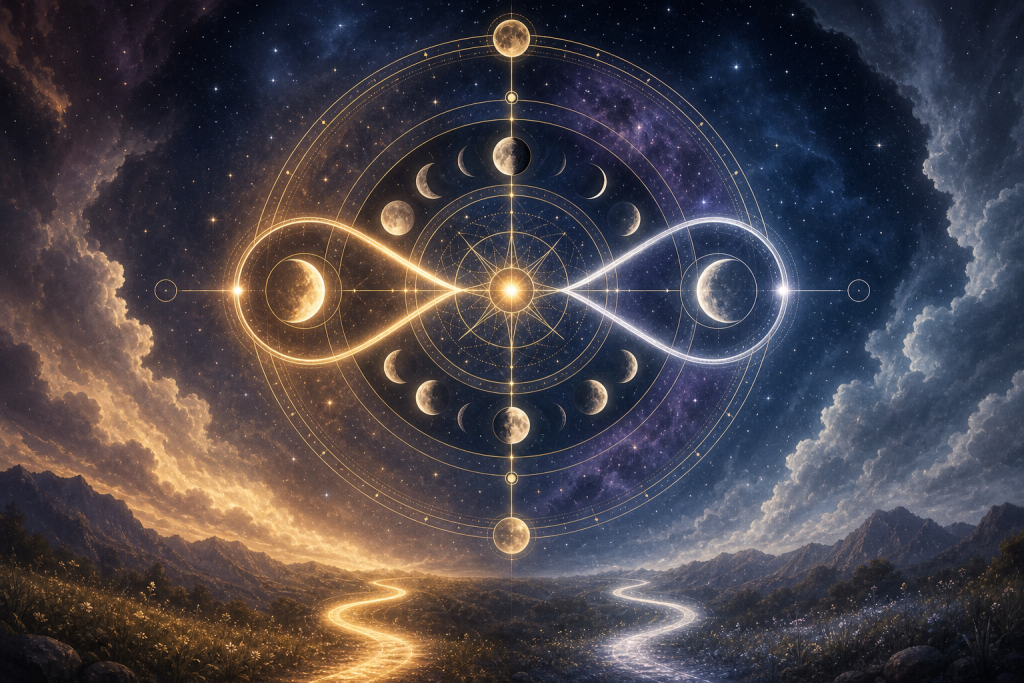
The lunar nodes are best understood as a pair. The North Node does not erase the South Node, and the South Node does not block the North Node. Instead, astrology often treats them as a balancing act between what is known and what is being developed.
A useful way to think about them is this:
- South Node: what comes naturally
- North Node: what requires more intention
- Together: a path from instinct to growth
This is why the nodes are often discussed in terms of life direction. The chart may suggest that a person is not meant to reject their natural gifts, but to use them in a new way that supports deeper development.
Why the House Placement Matters
While the sign tells you the style of the lesson, the house shows the life area where it tends to play out. This can make the nodes much more specific and practical.
For example:
- A North Node in the 4th house may point toward learning about home, roots, privacy, or emotional grounding.
- A North Node in the 10th house may emphasize responsibility, public life, or long-term career development.
- A North Node in the 7th house may highlight partnership, cooperation, and relational balance.
Reading the nodes by house helps connect the symbolism to real-life experiences. It also prevents overly vague interpretations, since the same sign placement can express itself differently depending on where it appears in the chart.
Common Misunderstandings About the Nodes
Because the nodes are often linked with destiny, they can be misunderstood as fixed instructions or moral judgments. Astrology is more nuanced than that. The nodes are symbolic, and different astrologers interpret them in different ways.
Here are a few common misunderstandings:
- “The North Node is always better.” Not necessarily. The South Node can contain real strengths.
- “The nodes predict fate with certainty.” Astrology is interpretive, not absolute.
- “Your North Node tells you exactly what career to choose.” It usually describes themes, not a single correct answer.
A more balanced reading treats the nodes as a guide to awareness, not a script.
How to Reflect on Your Own Nodes
If you want to explore your lunar nodes more personally, start with three questions:
- What behaviors or situations feel especially familiar and easy for me?
- What traits or experiences feel challenging but worthwhile to practice?
- How do the sign and house of my nodes change the meaning?
You can also look at the planets that aspect the nodes, since those connections may add pressure, support, or emphasis. A strong aspect from Saturn, for example, may make the nodal themes feel serious or disciplined, while a connection from Venus might soften the lesson through relationships or values.
In astrology, the lunar nodes are often read as a tension between comfort and growth, suggesting where a person may feel naturally capable and where they may be encouraged to evolve.
Why the Lunar Nodes Matter in Astrology
The lunar nodes matter because they add direction to the birth chart. While planets describe traits, drives, and tendencies, the nodes suggest a larger developmental story. They can help explain why certain choices feel repetitive, why some experiences seem especially meaningful, and where a person may be learning to stretch beyond old patterns.
That is one reason the nodes remain so central in modern astrology. They offer a symbolic way to think about purpose without reducing life to a single prediction. For many readers, that makes them one of the most practical and thought-provoking parts of chart interpretation.
Conclusion
The lunar nodes are not about fortune-telling in a rigid sense. They are a framework for understanding the balance between what feels familiar and what may help you grow. The South Node points to inherited habits or easy strengths, while the North Node points toward qualities that may develop through awareness and practice.
When you read them together, you get more than a personality snapshot. You get a map of movement, one that can help make sense of recurring themes, life lessons, and the kinds of experiences that shape your path over time.