
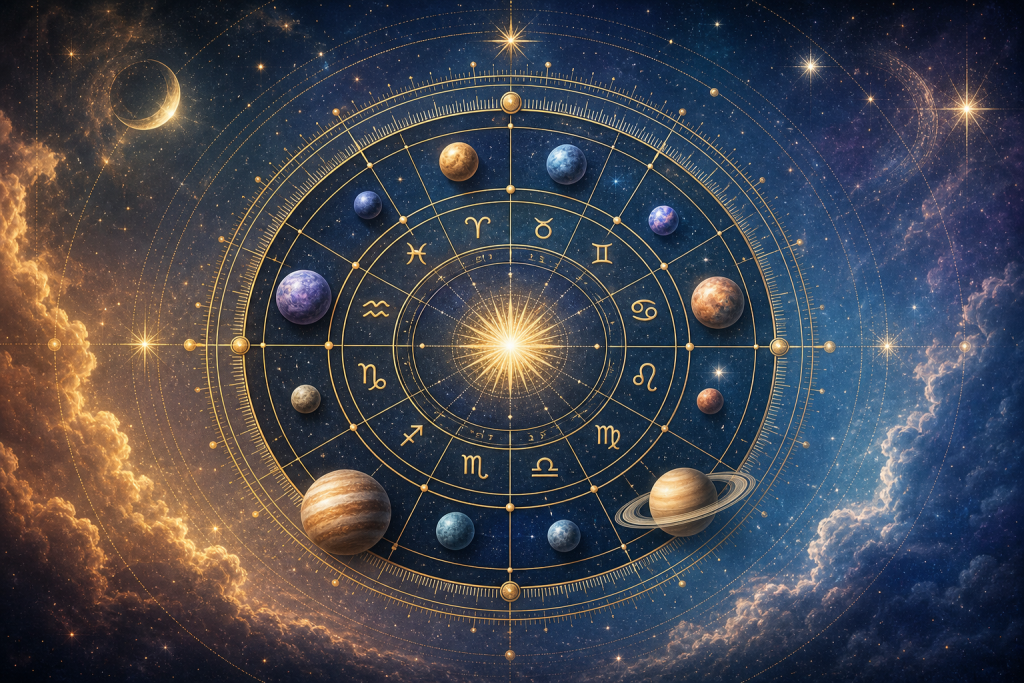
When people first learn astrology, they often focus on signs, planets, and houses. But there is another layer that can add precision and nuance: degrees. Every planet and point in a birth chart sits at a specific degree of a zodiac sign, and that exact placement can refine how an astrologer interprets timing, intensity, and expression.
Degrees are not a separate system from astrology; they are part of how the chart is measured. If two people both have Venus in Leo, for example, one may have Venus at 2 degrees Leo and another at 28 degrees Leo. Those placements can feel quite different in practice. Understanding degrees helps you move beyond broad sign descriptions and look more closely at the chart’s details.
What astrology degrees are
The zodiac is divided into 12 signs, and each sign contains 30 degrees. A full circle of the chart equals 360 degrees. So when you see a placement written as 14° Virgo, that means the planet is 14 degrees into the sign of Virgo.
Astrologers use degrees to describe how far a planet has progressed through a sign. This matters because the beginning, middle, and end of a sign can each carry a different tone. Degrees do not replace the sign itself; they add texture to it.
Why the exact degree can matter
Two planets in the same sign are not always identical in expression. A planet at an early degree may feel like it is just getting started in that sign’s energy. A planet at a late degree may feel more developed, urgent, or concentrated. While interpretations vary by tradition, degrees often help astrologers fine-tune their reading.
Degrees are especially useful when looking at:
- planetary aspects
- chart timing techniques
- chart points such as the Ascendant or Midheaven
- degrees that carry special symbolic meaning
Early, middle, and late degrees
Many astrologers interpret the zodiac in broad sections. The first 10 degrees of a sign are often described as early degrees, the middle 10 as middle degrees, and the last 10 as late degrees. These divisions are not universal rules, but they can help beginners notice patterns.
Early degrees may suggest a fresh, emerging quality. The planet can seem eager, direct, or new to the sign’s style.
Middle degrees are often read as balanced or stable. The sign’s energy may appear more settled and straightforward.
Late degrees can feel more intense or refined. Some astrologers see them as carrying a sense of completion, urgency, or accumulated experience.
These interpretations are subtle, not absolute. A chart should always be read as a whole rather than reduced to one number.
Critical degrees and symbolic points
Certain degrees have special meaning in astrology. These are often called critical degrees, anaretic degrees, or sensitive degrees, depending on the tradition. They are not meant to be feared. Instead, they can highlight places of emphasis in a chart.
The 0 degree
The 0 degree of a sign is sometimes associated with beginnings, raw energy, and a strong emphasis on that sign’s themes. A planet at 0 degrees may express the sign in a direct and unfiltered way.
The 29th degree
The 29th degree, often called the anaretic degree, is one of the most discussed points in astrology. It is the final degree of a sign and can symbolize culmination, urgency, or a need to fully work through the sign’s lessons. Some astrologers read this degree as especially noticeable because it sits at the threshold of change.
For example, Mars at 29 degrees Capricorn may express Capricorn themes with extra concentration or pressure compared with Mars in the middle of the sign. The exact interpretation depends on the rest of the chart.
Other notable degree patterns
Astrologers also pay attention to repeating degree patterns, such as multiple planets at the same degree or planets forming aspects at exact degrees. These patterns can create a stronger sense of connection between chart factors.
In astrology, the exact degree often acts like a fine-tuning knob: it does not change the whole chart, but it can change how clearly a theme stands out.
How degrees affect aspects
Aspects are the angles planets make to one another, and degrees are essential to calculating them. A conjunction, square, trine, or opposition is not just about signs being compatible or incompatible. It is about the actual distance between two points in the chart.
For example, if the Moon is at 15 degrees Taurus and Saturn is at 15 degrees Virgo, they form an exact trine by degree. If Saturn were at 18 degrees Virgo, the aspect would still exist, but it would be less exact. The closer the aspect, the stronger it is usually considered.
This is one reason degrees matter so much: they show whether a chart pattern is exact, close, or more widely separated.
Degrees in chart timing
Degrees are also used in timing methods. In transits, progressions, and other forecasting techniques, astrologers watch when planets move to exact degrees that activate natal placements. Even a small shift in degree can mark a meaningful change in emphasis.
For instance, if a transit planet reaches the same degree as a natal Sun, that contact may be treated as more significant than a looser alignment. Exact degree contacts often stand out in timing work because they can coincide with stronger symbolic focus.
That said, astrology timing is interpretive rather than deterministic. Degrees may indicate when a theme is highlighted, but they do not guarantee a specific event.
How to start reading degrees in your own chart
If you want to begin noticing degrees without getting overwhelmed, start simple.
- Look at the exact degree of your Sun, Moon, and Ascendant.
- Notice whether planets fall in the early, middle, or late part of a sign.
- Check for exact aspects between planets.
- See whether any planets are at 0 degrees or 29 degrees.
- Compare repeated degrees across the chart for possible emphasis.
As you practice, try not to force meaning into every number. Degrees work best when read alongside the sign, house, aspect, and planetary condition. A single degree rarely tells the whole story.
The bigger picture
Astrology degrees add precision, but they are only one piece of chart interpretation. They help explain why two placements with the same sign can still feel different. They also sharpen aspects and timing work, making the chart more detailed and nuanced.
If you are learning astrology, degrees are worth paying attention to once the basics feel familiar. They can deepen your understanding of how a chart operates without replacing the larger symbolic framework. In other words, degrees help astrology speak with more detail, not more certainty.
Used carefully, they can turn a broad chart reading into something more exact, thoughtful, and instructive.