
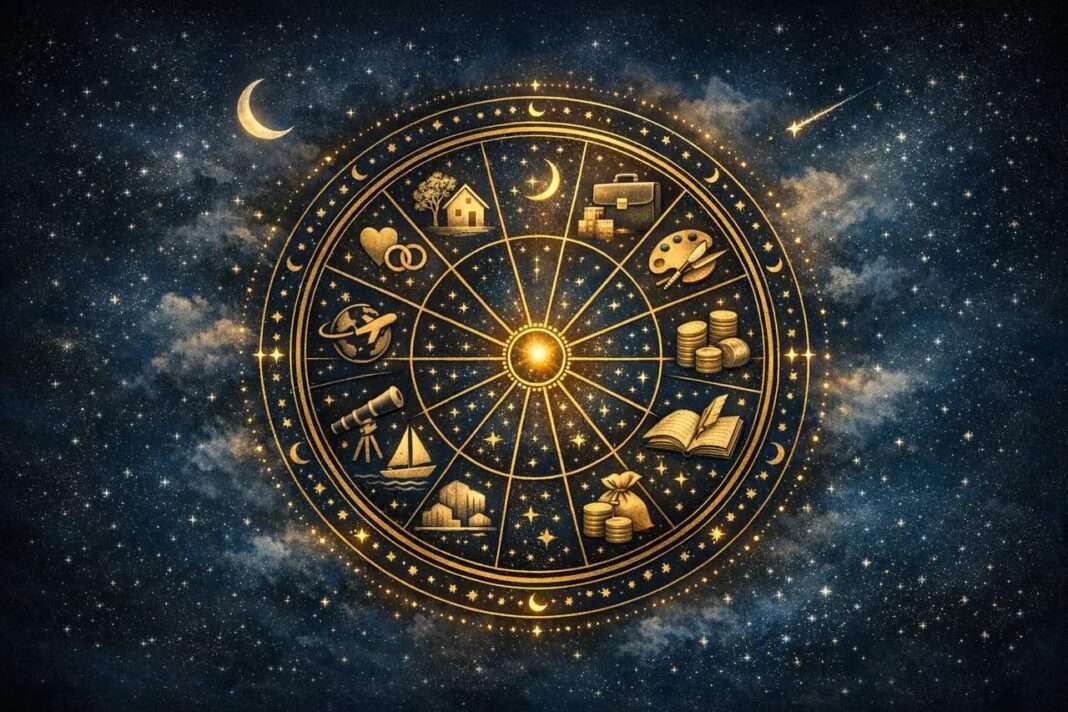
When people first start learning astrology, they often focus on zodiac signs and planets. But one of the most practical parts of a birth chart is the house system. If planets are the “what” of astrology, houses are the “where.” They show which areas of life are most active, noticeable, or meaningful in a chart.
Understanding the 12 houses can make astrology feel much more grounded and personal. Instead of reading a chart only as a personality snapshot, you begin to see how different life themes may show up in everyday experience. This article breaks down the astrology houses in a clear, beginner-friendly way.
What Astrology Houses Represent
In a natal chart, the sky is divided into 12 sections called houses. Each house corresponds to a different life area, such as identity, money, communication, home, relationships, work, and spirituality. The sign on the cusp of a house and any planets inside it help describe how that area may be expressed.
In simple terms:
- Signs describe style or expression.
- Planets describe energy or function.
- Houses describe life area or setting.
This is why two people with the same Sun sign can still have very different charts. Their planets may fall in different houses, shifting the focus of their lives in distinct ways.
The First Six Houses: Personal Foundations
1st House: Self and First Impressions
The 1st house is often called the house of identity. It relates to how you present yourself, how others first experience you, and the overall tone of your approach to life. It is closely tied to the Ascendant, or rising sign.
2nd House: Money, Possessions, and Self-Worth
This house deals with resources, personal values, and the sense of security that comes from what you own or build. It can describe attitudes toward earning, spending, and what feels valuable to you.
3rd House: Communication and Everyday Learning
The 3rd house covers speaking, writing, short trips, neighbors, siblings, and daily information exchange. It reflects how you think and share ideas in ordinary life.
4th House: Home, Family, and Roots
Often linked with childhood and private life, the 4th house points to your inner foundation. It can describe family patterns, home environment, and the need for emotional safety.
5th House: Creativity, Pleasure, and Self-Expression
This is the house of joy, play, romance, hobbies, and creative risk. It highlights what helps you feel alive and how you express your unique spark.
6th House: Routine, Health, and Service
The 6th house is associated with habits, daily work, responsibilities, and practical care. It can show how you organize your time and how you handle tasks that keep life running smoothly.
The Middle Houses: Relationships and Growth
7th House: Partnership and Commitment
Directly opposite the 1st house, the 7th house focuses on one-to-one relationships. This includes romantic partnerships, business alliances, and the kind of balance you seek with other people.
8th House: Shared Resources and Transformation
The 8th house is one of astrology’s most intense areas. It relates to intimacy, trust, shared finances, psychological depth, and major life transitions. It often points to the themes that require courage, vulnerability, or profound change.
9th House: Beliefs, Travel, and Higher Learning
This house explores meaning-making. It is connected to philosophy, religion, education, long-distance travel, and the search for perspective. The 9th house asks what you believe and how you expand your worldview.
10th House: Career, Reputation, and Public Life
The 10th house is linked to ambition, long-term goals, and how you are seen in the public sphere. It can reflect career direction, leadership style, and the legacy you want to build over time.
The Final Six Houses: Community and the Inner World
11th House: Friends, Networks, and Future Goals
The 11th house connects to groups, communities, social causes, and hopes for the future. It shows how you participate in collective spaces and what kinds of dreams you want to pursue.
12th House: Reflection, Solitude, and the Unseen
The 12th house is associated with privacy, retreat, intuition, and what operates below the surface. It can point to hidden patterns, spiritual practices, and the need for rest or solitude.
Astrology houses do not predict a fixed outcome. They describe the life areas where certain energies may be more noticeable, active, or meaningful.
How to Use House Meanings in a Birth Chart
To work with houses, start by finding which sign begins each house and which planets fall inside them. A house with several planets may feel especially active. A house with no planets is still important, because its sign and ruling planet can still shape that area of life.
For example, if your Moon is in the 4th house, emotional needs may be strongly tied to home, family, or private space. If Mercury is in the 3rd house, communication and learning may come naturally or feel especially important. The context matters more than any single placement on its own.
It also helps to remember that house meanings are symbolic, not literal. A 10th-house placement does not force a specific career, just as a 7th-house emphasis does not guarantee a certain relationship outcome. Instead, the chart suggests where attention may naturally gather.
A Simple Way to Remember the 12 Houses
If you want a quick memory guide, think of the houses as a life map:
- 1st–6th houses: personal identity, resources, communication, home, creativity, and habits
- 7th–12th houses: relationships, transformation, beliefs, career, community, and inner life
This structure moves from the self outward into the wider world, then back inward again. That pattern is one reason the houses are so useful in astrology: they show how personal experience connects to daily life, relationships, and larger purpose.
Conclusion
The 12 astrology houses give birth charts depth and context. They help explain where different energies may show up, from self-image and money to relationships, career, and reflection. Once you understand the houses, chart reading becomes less abstract and much more practical.
If you are learning astrology step by step, the houses are a strong place to start. They turn a chart from a list of symbols into a map of real-life themes, making astrology easier to interpret with clarity and nuance.